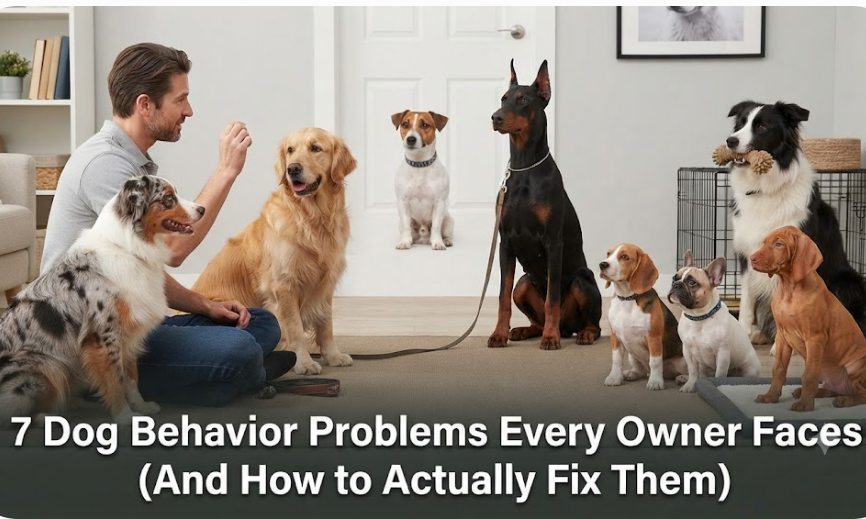

🐾 7 Dog Behavior Problems Every Owner Faces (And How to Actually Fix Them)
No punishment. No gimmicks. Just what actually works — backed by real training methods.
If you’ve ever Googled “why does my dog…” at 2am, you’re not alone. Every dog owner — new or experienced — runs into behavior problems eventually. The good news? Almost every common issue has a clear, fixable cause. Below are the seven struggles owners search for most, plus step-by-step ways to solve them.
💡 Quick Note: Behavior problems are rarely about a dog being “bad.” Most stem from unmet needs — exercise, mental stimulation, clear communication, or anxiety. Fix the root cause, and the behavior usually follows.
🗂️ What’s Covered
| 1 | Excessive Barking |
| 2 | Separation Anxiety |
| 3 | Destructive Chewing |
| 4 | Jumping on People |
| 5 | Leash Pulling |
| 6 | Reactivity & Aggression Toward Other Dogs |
| 7 | House-Training Regression |
1️⃣ Excessive Barking
Barking is communication, not misbehavior — the trick is figuring out what your dog is trying to say.
| Type | Likely Cause | Fix |
|---|---|---|
| Alert barking | Doorbell, noises, passersby | Block visual triggers (curtains, frosted film); teach a “quiet” cue paired with a treat the moment they stop |
| Attention-seeking | Barking gets you to look, talk, or react | Withhold attention completely until barking stops, then reward the silence |
| Boredom | Not enough physical/mental exercise | Add a daily puzzle feeder + one extra walk; tired dogs bark less |
⭐ Key tip: Never yell “quiet” at a barking dog — to them, it sounds like you’re barking along. Stay calm and reward silence instead of punishing noise.
2️⃣ Separation Anxiety
Signs include destructive chewing near doors/windows, howling, pacing, or accidents — but only when you’re gone.
Step-by-step fix: Desensitization
- Practice “fake departures” — grab your keys, put on shoes, but don’t leave. Repeat until your dog stops reacting to these cues.
- Leave for 30 seconds, come back calmly (no big greeting). Gradually increase to 1 minute, 5 minutes, 30 minutes over days/weeks.
- Give a long-lasting treat (frozen stuffed Kong) right before leaving, so alone-time becomes associated with something good.
- Keep arrivals and departures low-key — no dramatic hellos or goodbyes.
⚠️ When to see a vet: If anxiety is severe (self-injury, panic, non-stop howling), talk to a vet or veterinary behaviorist — anti-anxiety medication combined with training is sometimes necessary, and that’s completely okay.
3️⃣ Destructive Chewing
| Age | Most Likely Reason | Best Solution |
|---|---|---|
| Puppy (under 1 yr) | Teething, curiosity | Puppy-proof the space, offer appropriate chew toys, redirect (don’t punish) |
| Adult dog | Boredom, anxiety, excess energy | Increase exercise, add food puzzles, crate-train for unsupervised time |
The single most effective tool: management before correction. Put shoes away, use baby gates, and offer 3–4 appropriate chew options so your dog always has a “yes” alternative to the couch.
4️⃣ Jumping on People
- Turn away immediately when paws leave the ground — no eye contact, no talking, no touching.
- Reward “four on the floor” — the second all paws are down, mark it (“yes!”) and give a treat.
- Practice with guests — ask them to ignore the dog completely until it’s calm, then let it approach.
- Teach an alternative — a solid “sit” for greetings gives your dog a job to do instead of jumping.
⭐ Key tip: Consistency across every household member is critical. If one person allows jumping “just this once,” the behavior never fully goes away.
5️⃣ Leash Pulling
| Method | How It Works |
|---|---|
| Stop-and-go | The moment the leash goes tight, stop walking completely. Only move again once the leash slackens. Dogs learn pulling = walk stops. |
| Change direction | When your dog pulls ahead, calmly turn and walk the other way. Teaches them to keep checking in with you. |
| Front-clip harness | A management tool (not a fix) that redirects pulling force sideways instead of forward, useful while training is in progress. |
6️⃣ Reactivity Toward Other Dogs
Barking, lunging, or growling at other dogs on leash is usually fear or frustration — not dominance or aggression in the way people often assume.
- Identify your dog’s “threshold distance” — the closest another dog can get before your dog reacts.
- Stay just outside that distance and reward calm behavior every time another dog appears (this is called counter-conditioning).
- Slowly decrease the distance over many sessions — weeks, not days.
- Avoid forcing greetings. Reactive dogs improve faster with space, not exposure.
⚠️ Important: If reactivity involves biting or your dog has injured another animal or person, work with a certified professional dog trainer or veterinary behaviorist rather than DIY training.
7️⃣ House-Training Regression
A previously house-trained dog suddenly having accidents is a red flag worth investigating before assuming it’s “just behavior.”
| Possible Cause | What To Do |
|---|---|
| Medical issue (UTI, digestive upset) | Rule this out with a vet visit first — always the first step for sudden regression |
| Stress or routine change | Moving, new pet/baby, schedule change — go back to basics: frequent scheduled potty breaks + praise |
| Too much freedom too soon | Restrict access to open areas, reintroduce crate/gate management temporarily |
🎯 The One Rule That Fixes Almost Everything
Reward what you want, manage what you don’t, and stay consistent. Most “bad dogs” are actually under-exercised, under-stimulated, or unintentionally rewarded for the wrong behavior. Fix the setup, and the behavior usually follows.
This article is for general guidance only. For aggression, severe anxiety, or sudden behavior changes, consult a certified professional dog trainer or veterinarian.



댓글 남기기